Trees across Montgomery and Bucks Counties are under more pressure than they were even ten years ago. Warmer springs are activating fungal diseases earlier, and invasive pests that weren’t here a decade ago are now established.
That means more tree problems are showing up sooner — and sometimes more aggressively — than homeowners expect. Spots on leaves, sticky residue, and thinning canopies are often early warning signs. In Southeastern Pennsylvania, spring is when most pests and diseases become visible, and it’s the best time to catch them before they progress.
Key Takeaways
- Brown or tan blotches on leaves are usually anthracnose, while a white powdery film points to powdery mildew.
- Dark banding between leaf veins on beech trees is beech leaf disease, now confirmed throughout Pennsylvania and is one of the most serious emerging threats to these trees.
- Sticky residue on your deck or patio furniture is likely honeydew from sap-feeding insects, like scale or aphids, feeding in the canopy above.
- Spring is the best window for catching tree problems early, when most diseases and pests first become visible and the most treatment options are available.
- If you see multiple symptoms on the same tree, rapid decline over days, or anything you can’t confidently identify, call a Certified Arborist.
What Causes Spots or a White Coating on Tree Leaves in Spring?
Spots and white coatings on tree leaves are almost always caused by fungal diseases that activate in spring as temperatures and humidity rise. What you’re looking at depends on the type of spots and the tree they’re on.
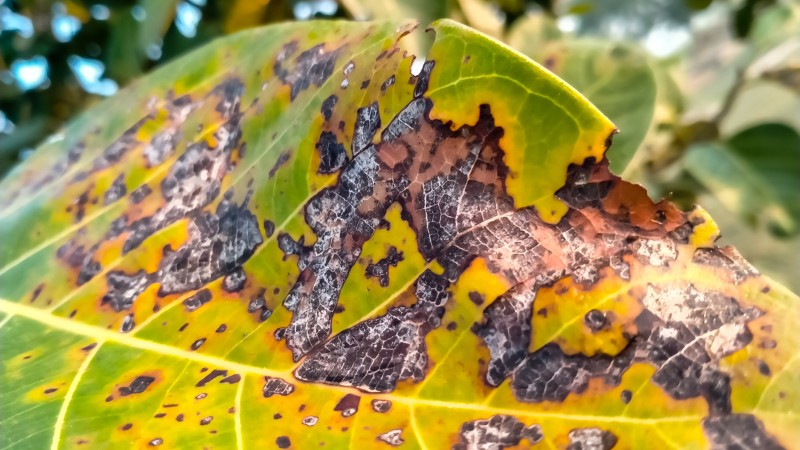
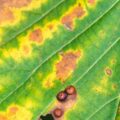
Leaf spots that start small can spread quickly in wet spring weather, eventually covering large sections of the leaf surface.
Brown or Tan Leaf Spots Are Often Anthracnose
Brown or tan blotches spreading across leaf surfaces are usually anthracnose, a fungal disease that kicks in once daytime temperatures consistently reach 50–55°F. The disease is most likely to affect common shade trees like sycamores, oaks, and dogwoods.
According to Penn State Extension, anthracnose can cause significant leaf drop and twig dieback, but most healthy trees bounce back with proper care.
Spots on Apple and Crabapple Leaves Are Often Apple Scab or Cedar-Apple Rust
Spots specifically on apple or crabapple leaves suggest a different set of problems. Dark, scab-like spots are a telltale sign of apple scab, one of the most widespread fungal issues for fruit trees in our area.
If the spots are bright yellow or orange instead, or you’re noticing strange orange tentacle-like growths on nearby junipers, that’s more likely cedar-apple rust. It only develops when both an apple tree and a juniper are growing close together.
White Coating on Leaves Is Usually Powdery Mildew
A white, powdery film is almost always powdery mildew, which thrives during humid, 60–80°F days. We typically see it develop in the spring, when conditions are ideal. It’s especially common on ornamental shrubs and dogwoods in shaded landscapes. It looks alarming, but it is rarely fatal.
Dark Bands on Beech Leaves Indicate Beech Leaf Disease
Dark bands running between leaf veins on beech trees are the signature symptom of beech leaf disease (BLD). The problem has become so bad that Buckingham Township put out an advisory to homeowners to watch for symptoms to control the spread and save beech trees.
The USDA Forest Service has highlighted beech leaf disease as a major problem in the northeast and has put our native beech population at risk. The disease is widespread throughout Pennsylvania, killing young trees within a few years and mature trees in several years without professional intervention.
One-Sided Yellowing Can Be Verticillium Wilt
Leaves yellowing between veins while the veins stay green, especially on one side of the tree, are a classic sign of verticillium wilt, a soil-borne disease that maples and ash trees are especially vulnerable to. There’s no cure, so catching it early is critical for deciding how to manage the tree going forward.
Why Are My Tree Branches Dying in Spring?
Branches die and canopies thin when a tree is fighting a disease, a pest infestation, or long-term stress. By the time you notice the problem, it has usually been building for a while. The cause depends on the species and what else you’re seeing.
Blackened Shoots on Fruit Trees Are Often Fire Blight
New growth that turns black and curls into a “shepherd’s crook” on apple or pear trees is fire blight, a bacterial disease that gets going once temperatures rise above 60°F and spreads quickly from there. Improper pruning can actually make it worse by moving the bacteria from branch to branch, so if you suspect fire blight, sterilize your tools between every cut or call a professional.
White Woolly Masses on Hemlocks Indicate Hemlock Woolly Adelgid
White, cotton-like masses at the base of needles on Eastern hemlocks are a sign of hemlock woolly adelgid, one of the most serious threats to Pennsylvania’s state tree. Left untreated, this pest can kill a hemlock within a few years, but it’s treatable if caught early.
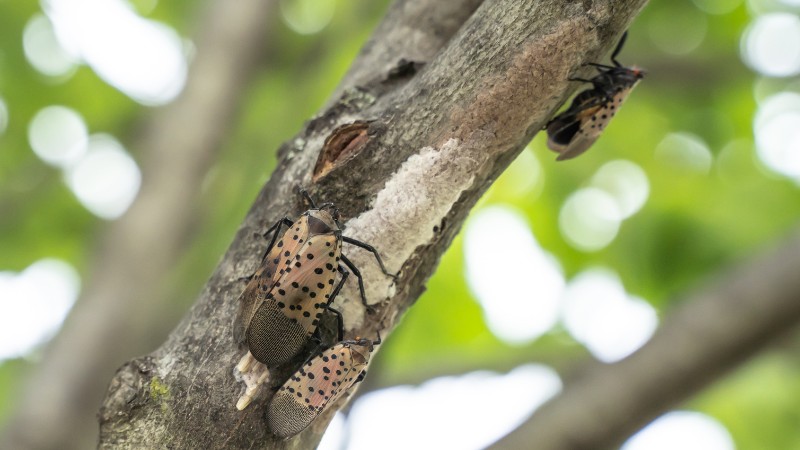
Spotted lanternfly adults and egg masses are easiest to spot on smooth-barked branches and trunks in spring before the canopy fills in.
What Are the Bugs or Egg Masses on My Tree?
Spotted lanternfly egg masses, leaf-chewing caterpillars, and emerald ash borer are among the most common insect problems homeowners notice on trees in Montgomery and Bucks Counties. How concerned you should be depends entirely on what you’re looking at.
Gray Mud-Like Masses Are Spotted Lanternfly Eggs
Flat, gray-brown egg masses that look like dried mud on bark, furniture, or vehicles are spotted lanternfly (SLF) eggs. SLF populations have dropped significantly in our area in recent years, but you may still find egg masses in spring on tree bark, outdoor furniture, and vehicles.
Chewed Leaves Are Usually Cankerworms or Japanese Beetles
Holes, ragged edges, or skeletonized leaves are the work of leaf-eating insects like cankerworms or Japanese beetles. This usually looks worse than it is, as healthy trees recover from moderate defoliation in a single season. The concern grows when heavy feeding happens year after year, weakening the tree over time.
D-Shaped Holes in Ash Bark Indicate Emerald Ash Borer
D-shaped exit holes in ash bark are a tell-tale sign of emerald ash borer (EAB), an invasive beetle that will kill an untreated ash tree within a few years. If you’re seeing these holes, the infestation may already be advanced. Preventive treatments are always more effective for EAB, as extensive feeding by larvae will quickly kill the tree and make it unsafe.
Small Bumps on Bark or Leaves Are Likely Scale Insects
You may also notice small, round, shell-like bumps on bark or leaf undersides — those are scale insects. They feed on tree sap and tend to go unnoticed because they don’t move or look like typical bugs. Heavy infestations can weaken branches over time, especially on ornamental trees and shrubs.
Sticky Residue or Black Mold Means Insects Higher in the Canopy
That sticky coating on your deck, car, or outdoor furniture isn’t tree sap; it’s honeydew. Sap-feeding insects, like scale, aphids, and spotted lanternflies, produce honeydew as they feed in the canopy above. The black coating that grows on top of it is sooty mold.
The honeydew and mold aren’t the real problem, although it is annoying. The real issue is that they’re evidence of an insect infestation you can’t see from the ground. If you’re noticing a sticky drip or black residue on your car or sidewalk, look up. Identifying and treating the pest causing it is the real solution.
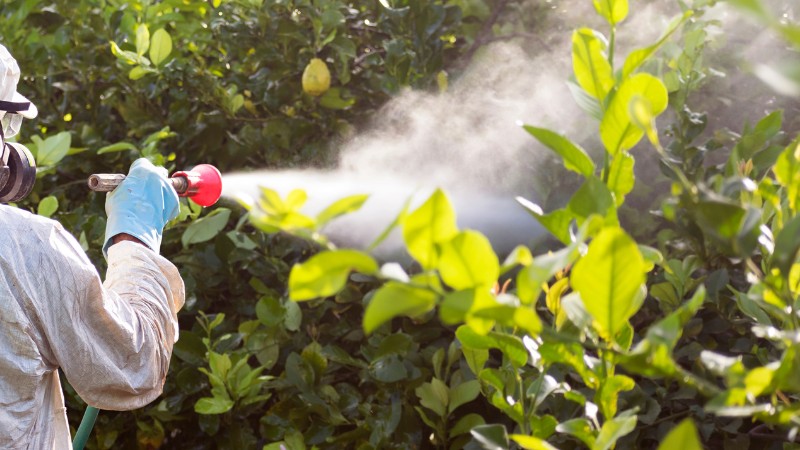
Targeted spray treatments are most effective in spring when insect and disease activity is just getting started.
Frequently Asked Questions
When Should I Have an Arborist Inspect My Trees for Pests or Disease?
You should have an arborist inspect your trees in early spring, ideally April or May in our area, when most diseases and pests first become visible, and you still have the full range of treatment options. If you notice the problem later in the season, it is still worth having an arborist inspect your trees to determine if there is something to do now or wait for next year.
Can a Tree Recover from Disease on Its Own?
Some diseases, like powdery mildew, are mostly cosmetic, and healthy trees push through them. Others, like beech leaf disease and verticillium wilt, are progressive; without treatment, they get worse. The key is identifying what you’re dealing with, so you know whether to wait or act.
Should I Remove a Tree with Disease or Try to Save It?
It depends on the disease, how far it’s progressed, and the tree’s overall health. Many diseases are treatable if caught early. A Certified Arborist can assess whether treatment or removal makes more sense for your situation.
How Do I Know If Spots on My Tree’s Leaves Are Serious?
A few spots aren’t necessarily cause for alarm, as some minor spotting is normal in wet springs. But if spots are spreading quickly, covering large portions of the canopy, or accompanied by branch dieback, it’s time for a professional evaluation.
Can Tree Diseases Spread to Other Trees on My Property?
Some tree diseases spread easily to other trees, while others stay contained. Fungal diseases, like anthracnose and powdery mildew, spread through airborne spores, putting nearby trees at risk. Beech leaf disease can also move between neighboring trees.
Others, like verticillium wilt, live in the soil and don’t spread through the air, though they can still affect multiple trees growing in the same area.
If you’re seeing symptoms on one tree, it’s worth having an arborist take a look to determine whether the issue could spread and what steps, if any, are needed to protect the rest of your landscape.
Don’t Wait to Address Tree Problems This Spring — Call Clauser Tree Care
If something looks off with your trees this spring, trust what you’re seeing. You don’t need to be an arborist to notice that a branch is dying, leaves look wrong, or something sticky is coating your deck. You just need to know when it’s time to call a professional. Spring is the best time to catch insect and disease problems early to protect your trees.
The team at Clauser Tree Care is here to help this spring. Our arborists will inspect your trees, diagnose the problem, and help put them on the path to recovery. Give us a call at 215-542-8291 or request a free quote online.
About Clauser Tree Care
From who you talk to on the phone in our office, to our courteous and experienced work crews who provide your service, all of the hard-working team members at Clauser Tree Care strive for complete client satisfaction. Our job is simply not done until you are pleased with the experience that you have had working with our company. Founded more than 25 years ago on the principles of honest work and arboricultural best practices, we strive for a higher standard of care for a greener future.