
If you’re seeing dark bands between the veins on your beech leaves this spring, it’s not just a cosmetic issue. It’s often the first sign of beech leaf disease – a condition that’s now been confirmed in Southeastern Pennsylvania.
Buckingham Township’s June 2025 announcement made it clear that this disease is no longer a distant concern. Early detection in spring, when leaves first emerge, gives homeowners the best chance to slow its progression and protect mature trees.
Key Takeaways
- Beech leaf disease is caused by microscopic nematodes that overwinter in buds, making spring the optimal detection window when damage becomes visible.
- Dark green banding between leaf veins is the earliest and most reliable symptom to watch for on newly emerged leaves.
- Early detection allows for treatment options that can slow progression and extend tree life significantly.
- Preventing spread to healthy beech trees requires immediate professional assessment and proper material handling.
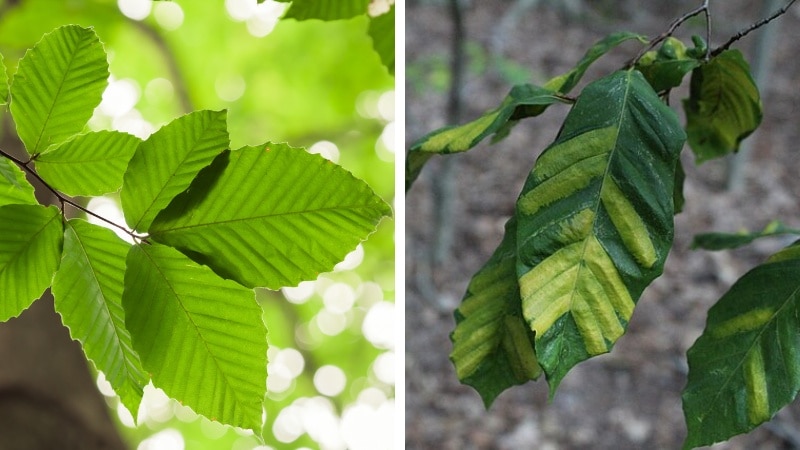
Healthy beech leaves (left) appear uniformly bright green, while beech leaf disease symptoms (right) create distinctive dark striping parallel to leaf veins. Photo courtesy of usfs_Eastern_Region, Public domain, via Wikimedia Commons.
What Is Beech Leaf Disease?
Beech leaf disease is a serious and often fatal condition affecting beech trees across Pennsylvania. It’s caused by microscopic nematodes that feed on developing leaf tissue, disrupting the tree’s ability to photosynthesize and store energy. Over time, this stress leads to canopy decline and, eventually, tree death if left unmanaged.
Microscopic nematodes called Litylenchus crenatae (LCM) feed on developing leaf tissue inside buds throughout the winter. When spring arrives and new leaves emerge, the damage becomes visible as the dark banding between leaf veins that homeowners often notice first.
As the season progresses, nematodes spread to nearby beech trees, continuing the cycle. While there is currently no cure, early intervention can help slow the disease and protect surrounding trees from becoming infected.
How Quickly Beech Leaf Disease Is Spreading in Pennsylvania
Beech leaf disease is now widespread in Pennsylvania and
spreading rapidly throughout Montgomery and Bucks Counties. It threatens both native American beech and ornamental European beech varieties commonly found in residential landscapes.
This aggressive disease kills young saplings within 1-2 years and mature trees within 7-10 years without intervention, making it one of the most serious emerging threats to local tree populations.
PRO TIP: For a deeper look at how this disease spreads and impacts trees, Penn State Extension provides a detailed guide to beech leaf disease that explains the science behind this emerging threat.
What are the Symptoms of Beech Leaf Disease?
Spring inspection requires knowing what to look for, when to look, and how to distinguish between healthy and diseased foliage during the critical early detection window.
The most reliable early symptom to watch for involves dark green to black banding that appears between leaf veins, creating distinctive stripes that run parallel to the leaf’s natural vein pattern. This banding typically appears darker than the surrounding leaf tissue and gives affected leaves a slightly striped appearance that experienced arborists can spot from considerable distances.
Unlike other leaf problems, this banding appears immediately when leaves emerge and remains consistent throughout the growing season.
Aside from the banding, affected leaves often feel slightly thicker or more leathery compared to healthy foliage on the same tree, though this texture difference can be subtle in early stages. The symptoms typically start appearing in the lower canopy where nematode populations establish first, then gradually spread upward as the disease progresses throughout the tree’s structure.
How to Inspect Your Tree for BLD Symptoms
Spring offers the best inspection conditions because symptoms appear most clearly on fresh, newly emerged leaves. Use these techniques for effective detection:
- Inspect on bright, sunny days when symptoms become backlit and most visible against the sky.
- Use binoculars to examine upper canopy areas without disturbing the tree or climbing.
- Focus on looking up into the canopy rather than examining only eye-level branches.
- Take detailed photos if uncertain, as banding can appear subtle initially but becomes clearer as you learn the pattern.
- Compare against healthy leaves on the same property or neighboring unaffected trees.
What Should You Do If You Find Beech Leaf Disease on Your Trees?
Finding suspected BLD symptoms requires a careful, methodical response that balances urgency with proper precautions to prevent further spread. If you suspect beech leaf disease, take these steps:
- Document symptoms right away with clear photos showing the dark banding pattern.
- Contact a Certified Arborist for a professional diagnosis, since early intervention can slow progression and extend the tree’s life.
- Avoid pruning or disturbing the tree, as this can spread nematodes to other parts of the tree or contaminate tools.
- Do not move plant material (leaves, branches, or twigs) from the tree, as it can carry the disease to other areas.
Can You Treat Beech Leaf Disease in Beech Trees?
Beech leaf disease cannot be cured, but it can be managed – especially when caught early. Treatment focuses on slowing disease progression, improving tree health, and extending the life of the tree.
Treatment options are most effective when applied early in the growing season while trees are still in relatively good condition. Phosphite soil treatments can help reduce stress and slow decline when applied by licensed professionals using proper timing and techniques.
Trunk injection treatments using specialized equipment show promising results in research studies, though these require professional application and careful monitoring to ensure effectiveness. The best treatment results have come from Arbotect 20-S trunk injections performed by experienced arborists.
PRO TIP: Speak with an arborist about whether saving your tree through professional treatment makes sense compared to removal and replacement with disease-resistant species. This will depend on the condition of the tree and how valuable it is to your property.

Professional treatment for beech leaf disease requires specialized chemicals and application equipment only available through licensed arborists.
How Can You Protect Healthy Beech Trees?
Prevention strategies focus on maintaining tree health, preventing disease introduction, and planning for long-term landscape sustainability in an area where BLD continues spreading. Supporting overall tree health provides the foundation for disease resistance and helps healthy trees withstand potential infection pressures from nearby affected properties.
Focus on these essential care practices:
- Maintain proper watering schedules during dry spells.
- Apply organic mulch around the base while keeping mulch several inches away from the trunk to prevent moisture retention that could encourage other problems.
- Provide appropriate fertilization to support tree vigor and natural disease resistance, especially during spring, when trees need nutrients for new growth.
- Avoid soil compaction around root zones from foot traffic, vehicle parking, or heavy equipment operation, since stressed root systems make trees more vulnerable to all diseases.
- Address other tree stresses promptly, such as construction damage, poor drainage, or mechanical injuries that could weaken trees’ natural defense mechanisms.
- Monitor for early symptoms of diseases to avoid additional stress or damage to your tree; call an arborist for help with disease management as soon as you see symptoms.
- Plant a varied range of tree species to avoid one disease spreading throughout your entire property.
Frequently Asked Questions About Beech Leaf Disease
How quickly does beech leaf disease spread between trees?
BLD can spread rapidly through nematode movement in soil and on contaminated tools or materials. Adjacent trees often show symptoms within 1-2 years of initial detection, though spread rates vary depending on soil conditions, tree proximity, and human activity that might move contaminated material.
Can I treat beech leaf disease myself with store-bought products?
No effective home treatments exist for BLD. Professional treatment requires specialized chemicals and application techniques that are only available through licensed arborists with proper equipment and training.
When should I call a professional arborist about beech leaf disease?
Contact a Certified Arborist immediately if you suspect BLD symptoms, especially the characteristic dark banding between leaf veins. Early professional diagnosis and treatment planning significantly improve outcomes and can extend tree life by several years compared to waiting until symptoms become severe.
Should I remove my beech tree if it shows BLD symptoms?
Not necessarily. Infected trees caught early can often be managed for several additional years with proper treatment, maintaining property value and landscape benefits. Professional assessment can determine whether treatment or removal represents the best option based on disease progression and tree condition.
Is beech leaf disease dangerous to humans or pets?
No, BLD poses no direct health risks to people or animals. The concern is purely for tree health and property safety from declining trees that could become hazardous over time.
What other tree species are at risk from beech leaf disease?
Currently, beech leaf disease only affects beech trees, including both native American beech and ornamental European beech varieties. Other tree species are not susceptible to this particular nematode.
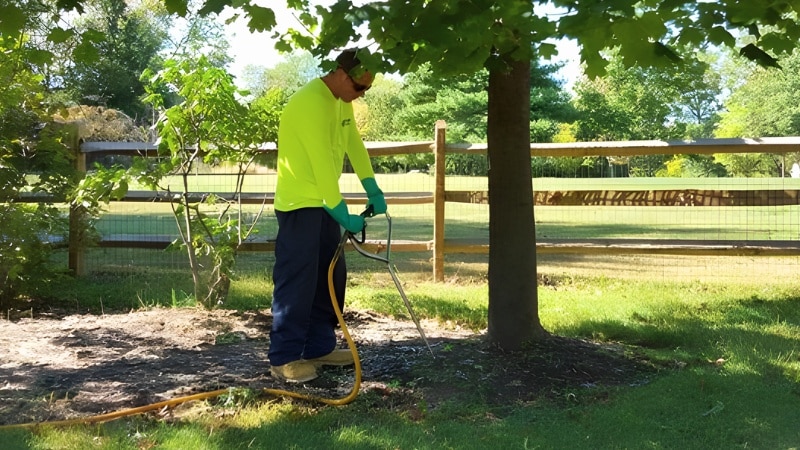
Trunk injection treatments using Arbotect 20-S show the most promising results for managing beech leaf disease when applied early in the infection.
Don’t Wait – Keep Your Valuable Beech Trees Thriving with Help from Clauser Tree Care
Spring’s arrival in Montgomery and Bucks Counties brings both opportunity and urgency for Pennsylvania homeowners dealing with beech leaf disease detection. The disease is now spreading rapidly throughout the region, and early professional intervention can be the difference between a healthy beech tree and one that needs prompt removal.
Clauser Tree Care has been helping homeowners across Montgomery and Bucks Counties manage tree health issues like beech leaf disease with clear, honest recommendations. If you’re seeing signs of BLD or want a professional assessment, we can evaluate your tree and walk you through the next steps. Call us at 215-337-4022 or request a quote online today!
About Clauser Tree Care
From who you talk to on the phone in our office, to our courteous and experienced work crews who provide your service, all of the hard-working team members at Clauser Tree Care strive for complete client satisfaction. Our job is simply not done until you are pleased with the experience that you have had working with our company. Founded more than 25 years ago on the principles of honest work and arboricultural best practices, we strive for a higher standard of care for a greener future.