
When most Montgomery and Bucks County homeowners think about tree pest management, winter rarely comes to mind. However, the cold months between December and February present the most strategic opportunity for protecting your mature trees from the region’s three most devastating invasive pests: emerald ash borer, spotted lanternfly, and spongy moth.
Winter dormancy creates unprecedented detection opportunities that simply don’t exist during active growing seasons. For homeowners in established neighborhoods, like Doylestown, Blue Bell, and Ambler, winter tree pest evaluations can mean the difference between saving valuable mature trees and watching them decline.
Key Takeaways
- Winter dormancy creates optimal detection conditions when pests remain stationary and trees are bare, allowing clear access to EAB larvae, spotted lanternfly egg masses, and spongy moth eggs.
- December through February is the critical assessment window before spring emergence begins and overwintering pest stages become active and mobile.
- Winter findings enable precise treatment timing for systemic EAB applications, targeted egg mass removal, and properly scheduled suppression treatments.
- Professional evaluation reveals property-specific risks based on tree species, location factors, and transportation corridor exposure patterns.
- ISA Certified Arborists maximize detection advantages through comprehensive assessments and customized management protocols that prevent spring damage.
What Makes Winter the Best Time for Tree Pest Detection?
The science behind effective winter tree pest evaluation lies in understanding how these invasive species survive Pennsylvania’s cold months. Unlike warm-season inspections, where active insects may hide, move, or remain concealed by foliage, winter dormancy creates ideal conditions for comprehensive pest detection.
During the winter months, the three major invasive pests affecting our trees enter distinct overwintering phases that make them easier to detect and assess. While bare deciduous trees allow complete canopy inspection, safer equipment access, and clearer sight lines for detecting pest evidence.
How to Detect Tree Pests During Winter Months
While pests are not active in the winter, now is the perfect time to check your trees for signs of pest activity.
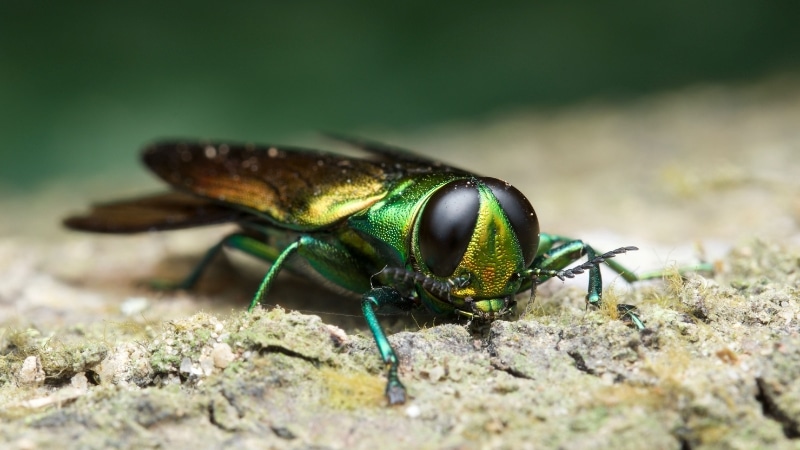
Adult emerald ash borer beetles emerge in late spring, but winter detection focuses on overwintering larvae beneath bark.
How to Find Emerald Ash Borer in Winter
Emerald ash borer poses the most immediate threat to Montgomery and Bucks County ash populations, with established populations throughout Pennsylvania since 2007. During winter months, EAB larvae enter a dormant state called diapause, settling into chambers within ash tree bark, where they remain stationary until spring.
Winter EAB evaluation focuses on identifying characteristic D-shaped exit holes from previous seasons, bark splitting patterns, and canopy thinning that becomes apparent against the winter sky. Certified Arborists examine bark texture changes for slight vertical splits indicating larval feeding galleries beneath. The overwintering period reveals EAB population density through exit hole counts and gallery pattern analysis.
In Doylestown, the borough’s historic tree population includes numerous mature ash specimens that represent prime EAB targets due to their size and urban stress factors. Early winter detection is critical for community-wide management as EAB spreads rapidly between properties in compact neighborhoods.
For EAB management, winter detection directly informs spring systemic treatment applications. Emamectin benzoate and imidacloprid applications must occur before adult emergence, typically late April through early May in southeastern Pennsylvania. Winter larvae density information guides treatment priorities and dosage calculations.
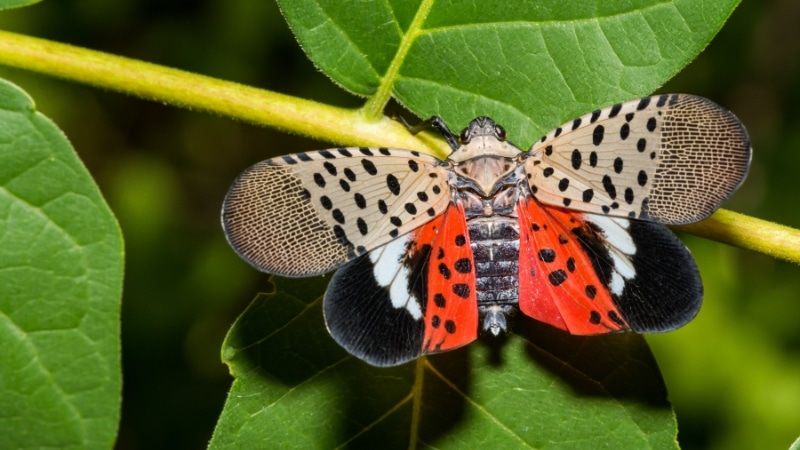
While adult spotted lanternflies are visible in summer and fall, winter egg mass detection is critical for population control.
How to Identify Spotted Lanternfly Egg Masses in Winter
Spotted lanternfly management hinges entirely on winter egg mass detection, as this represents the pest’s only stationary life stage. USDA guidelines emphasize winter as the critical window for egg mass destruction, with each mass containing 30-50 viable eggs that will emerge as nymphs in late April through May.
Winter spotted lanternfly evaluation requires systematic property surveys, as females deposit 30-50 eggs per mass during fall months, covering them with a protective waxy coating that hardens into a distinctive gray-brown appearance. These egg masses remain attached to tree trunks, branches, and outdoor surfaces throughout winter, providing a stationary target for systematic location and documentation.
Properties near transportation corridors face particular spotted lanternfly risks, as vehicles frequently transport egg masses between properties. Ambler and Lower Gwynedd neighborhoods present mixed mature tree populations near commuter rail and highway corridors, creating a high risk of spotted lanternfly spread.
Proper egg mass destruction requires physical scraping and alcohol treatment, with work completed before April hatching begins. Winter evaluation identifies introduction points and guides targeted removal efforts before spring emergence occurs.
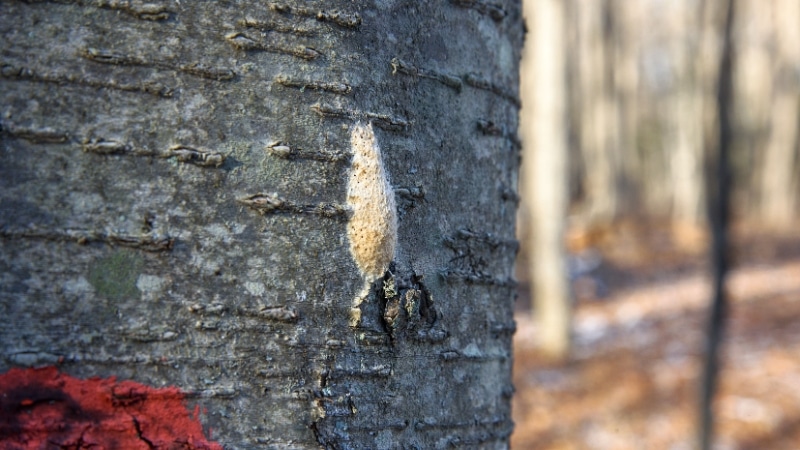
Winter spongy moth egg masses are easily identified by their distinctive tan, velvet-like covering and teardrop shape.
How to Spot Spongy Moth Egg Masses Before Spring
Spongy moth populations in Pennsylvania follow cyclical patterns, with periodic outbreaks occurring every 5-10 years throughout the state. Winter egg mass surveys provide the foundation for predicting spring defoliation risks and planning intervention strategies.
Each spongy moth egg mass contains 500-1,000 eggs covered in tan, velvety hairs from the female’s abdomen. These masses weather from dark tan to light gray over the winter months, but remain identifiable through their distinctive teardrop shape and fuzzy texture. Penn State Extension recommends winter surveys as the critical period for population assessment, as spring emergence makes individual egg detection impossible.
Blue Bell and Penlyn areas feature extensive wooded estates with large mature native oaks, particularly susceptible to spongy moth infestations. Winter evaluations in these areas focus on systematic surveys of oak groves, where egg mass concentrations can reach outbreak levels.
IMPORTANT: A single spongy moth egg mass can contain up to 1,000 eggs. Just 10 egg masses surviving winter in your oak trees could release 10,000 caterpillars by May, creating an immediate defoliation risk that requires professional intervention.
Spongy moth control depends heavily on winter egg mass survey results. High-density areas require precise Bacillus thuringiensis (Bt) application timing, typically early to mid-May when first and second instar larvae are most susceptible. Treatment effectiveness decreases rapidly as larvae mature, making winter survey data essential for scheduling optimal application windows.
Why Hire an Arborist for Winter Pest Evaluation?
Professional winter tree pest evaluation requires specialized knowledge and diagnostic skills that distinguish ISA Certified Arborists from general tree service providers. Certified Arborists possess the technical expertise to distinguish between pest damage symptoms and other tree health issues during winter inspections, preventing misidentification errors that could lead to inappropriate treatment recommendations.
Winter evaluation safety protocols represent another critical advantage of professional service. Inspecting tall trees during cold months requires proper equipment, climbing techniques, and hazard assessment procedures that trained arborists manage through appropriate gear and methodologies.
Frequently Asked Questions About Winter Tree Pest Evaluations
When exactly should I schedule a winter tree pest evaluation?
The optimal window runs from mid-December through February, after deciduous trees have dropped their leaves but before spring warmup begins activating overwintering pests. January often provides the best conditions, as egg masses and dormant larvae remain stationary while weather conditions allow safe access for comprehensive property surveys.
Can winter pest evaluation findings be integrated with other tree health services?
Absolutely. Winter evaluations often identify additional tree health issues, including storm damage, structural concerns, and disease symptoms. Many homeowners schedule comprehensive winter tree health assessments that combine pest evaluation with:
- Dormant season pruning
- Cabling installation
- Soil amendment planning
How effective is winter pest evaluation compared to spring and summer monitoring?
Winter evaluation provides unmatched detection accuracy because pests remain stationary and visible without foliage interference. Spring emergence makes individual pest tracking difficult, while summer inspections often identify damage after significant harm has already occurred. Winter assessment allows proactive intervention before pest populations become active.
Do I need separate evaluations for different pest species or one comprehensive assessment?
A single comprehensive winter evaluation covers all major overwintering pests affecting your property. ISA Certified Arborists systematically survey for EAB, spotted lanternfly, spongy moth, and other pest species during one thorough inspection. This integrated approach is more efficient and cost-effective than separate pest-specific evaluations.
Schedule Your Professional Winter Tree Pest Evaluation Today with Clauser Tree Care
Don’t wait until spring pest emergence reveals problems that could have been prevented through strategic winter evaluation. The dormant months provide your best opportunity to protect Montgomery and Bucks County trees through early detection and precisely timed treatment planning.
Clauser Tree Care’s ISA Certified Arborists conduct comprehensive winter pest evaluations throughout Chalfont, Doylestown, Ambler, Blue Bell, and surrounding communities. Our systematic approach combines technical expertise with local knowledge to develop customized management strategies that preserve your valuable mature trees.
Contact us at 215-542-8291 to schedule your winter tree pest evaluation, or request a free estimate through our website.

About Clauser Tree Care
From who you talk to on the phone in our office, to our courteous and experienced work crews who provide your service, all of the hard-working team members at Clauser Tree Care strive for complete client satisfaction. Our job is simply not done until you are pleased with the experience that you have had working with our company. Founded more than 25 years ago on the principles of honest work and arboricultural best practices, we strive for a higher standard of care for a greener future.